
Fear—or the unhappy feeling of never truly being heard when one is a researcher working on major societal issues—is very widespread. More rarely do researchers express the fear that their work might in fact be counterproductive and may actually contribute to exacerbating the very problems they study. I often feel this fear with Life Cycle Assessment (LCA), and more generally with the modeling of relationships between Humanity and the Environment.
This fear troubles me, because when I was younger I was haunted by Sartre’s concern—What does it mean to write in a world that is hungry?—which resonated deeply within me and led me to choose a discipline directly engaged with the world and its suffering. Paradoxically, this anxiety may in fact be amplified, because literature would at least serve beauty. If modeling and quantifying the world did not even change it, then it would be a perfectly odious occupation. I think here of Marx’s last thesis on Feuerbach, criticizing the idealism and incomplete materialism that occupied the first half of the nineteenth century in philosophy: « The philosophers have only interpreted the world, in various ways; the point, however, is to change it. » (Marx,1845).
THE oPPOSITIONALITY OF SCIENCE
The powerful Church fought the rise of the natural sciences, burning Giordano Bruno, imprisoning Galileo, and opposing Darwin, because these sciences challenged its mythology and therefore its power. The rise of the bourgeoisie, by contrast, glorified the natural sciences because they enabled the development of productive forces, increases in productivity and the associated profits, and therefore the power of the bourgeoisie.
Sociology, if it is not placed in the service of advertising, the manufacture of consent, and the maintenance of order, is the enemy of the bourgeois order because it sheds light on the falsity of capitalist and neoliberal myths. Human and natural sciences share a common quest for knowledge that illuminates the functioning of the world. Yet most of the knowledge produced by the natural sciences does not directly oppose the bourgeois order, which can instead use it to its advantage.
By contrast, the social sciences that study social organization undermine the fables that sustain the bourgeois order: meritocracy, the “value of work” (the work of others), the supposedly natural necessity of social inequalities, racism, and so on.
In seeking truth, these sciences enter into opposition with the false world described by Adorno and dear to Lagasnerie. They are oppositional simply by striving to reveal truths buried beneath the alienation and domination that shape the relationship of human beings to the world within their social organizations. To engage in a pursuit of truth is already to take a position of opposition. The pleonasm of the “committed intellectual” or the “engaged scientist” then becomes apparent.
Today, the most oppositional of the natural sciences is perhaps environmental science. Astronomy no longer has the same disruptive potential as it did in the time of Giordano Bruno; current systems of domination no longer rest on biblical geocentrism. The collapse of living systems and of the Earth’s habitability conditions, however, constitute far more troubling truths for the capitalist order.
Climate science and environmental science more broadly are among the primary targets of the fascist MAGA movement—the culmination of an exacerbated form of American capitalism, whose temporary ambassador George Bush was already proclaiming at the 1992 Rio Summit that the “American way of life is not negotiable.”
The social sciences are also violently attacked, including in France—albeit to a different degree—where the hunt for “Islamo-leftism” (a vague conspiratorial concept, the new “Judeo-Bolshevism” of the era) within universities has become a recurring theme. This hunt reached a peak with the 2021 announcement by the French Minister of Higher Education and Research, Frédérique Vidal, calling for an investigation into the supposed presence of this movement within French research.
The suspicion directed at academics—who are accused of knowingly producing discourses in the service of the “parasites” that are the most dominated social groups, and of acting as agents of division of national unity and enemies from within—is a fundamental component of the reactionary dynamic of late capitalism, which readily embraces anti-intellectualism.
Given this context, how is it that a scientific discipline such as industrial ecology—and more specifically Life Cycle Assessment (LCA)—is so legitmized and aligned with the spirit of the times?
Born in the 1980s and solidly theorized in the 1990s, LCA rapidly conquered academic, industrial, and institutional spheres, as evidenced by the multiplication of LCA consulting firms, dedicated departments within large companies, and legislative efforts such as the Product Environmental Footprint initiative at the European Union level. Given the context described above, one might expect that a discipline combining environmental science, management and economic sciences, and the social sciences would face strong opposition. On paper, LCA and its developments constitute a science of the environmental impacts of our productive system and could therefore pose problems for the owners of the most polluting industries. Likewise, the need to mobilize environmental ethics—essential for determining the protection areas considered and the weightings between environmental impacts—as well as accounting, economics, and even other social sciences in its most advanced developments, could make LCA modeling a particularly oppositional field. Such oppositionality, once again, would not require any additional commitment: the simple act of revealing the falsity of the world already makes scientific practice oppositional in fact.
Yet the enthusiasm surrounding LCA seems to indicate broad acceptance of the practice. This does not mean that LCA cannot be oppositional, nor that it never is, as we will see. Nevertheless, in its most common practice it threatens nothing that is established and is largely harmless to the structures that exacerbate the destruction of the world and of sentient beings. Let us therefore try to understand why—and how it might become otherwise.
A RESPONSABILITY NARRATIVE
In the overwhelming majority of cases, LCA attributes impacts to products or services, or to the demand for them, and the impact is ultimately borne by the final consumer. The associated worldview is therefore compatible with the neoliberal discourse of a market in which companies merely respond to the demands of perfectly free individuals whose consumption may be more or less virtuous. “If it didn’t sell, people would simply stop buying it,” and if we determine what should not be bought, we can tell people. If they still buy it, they are morally at fault. The company selling the product is not at fault at all; it is even virtuous, since it responds to consumer demand. The notion of the personal environmental footprint assigns each individual “their impact,” and this impact comes solely from their consumption. A shareholder who pressures a company to launch marketing campaigns in order to boost product sales will not see their environmental footprint increase. But why not? If we are willing to say that a consumer is responsible for the impacts associated with buying a product, it is because we assume that without their demand the product and its impacts would not exist. This counterfactual vision notably dominates the consequential LCA approach, where an actor is responsible in proportion to the consequences of their decision (Weidema et al., 2018). Consequences are defined by invoking a counterfactual situation in which the studied decision did not occur. If shareholder pressure leads to 1,000 additional consumers buying the product, the counterfactual world without that pressure would indeed be a world with lower impacts. The impacts normally attributed to each of these new consumers should therefore belong to the shareholder’s footprint, since without him they would not have become consumers. But perhaps that shareholder exerted pressure to increase dividends because he feels unloved by his father, who always made it clear he preferred the brother who succeeded better in business. In that case, the father becomes responsible for the impacts of those 1,000 consumers, because without his behavior his son would not have acted in that way.
As we see, causal chains are infinite, and determining consequences requires constructing counterfactual scenarios to which we do not actually have access. What would the son have done if his father had shown him more affection? Who can say he would not have developed a superiority complex instead of an inferiority complex—pushing him to extract even more dividends from the company? The notion of responsibility is constitutive of the fictions upon which our social order rests. It may be a necessary fiction for some, but it is not a truth of the physical world. As Weidema et al. (2018) note, there is no objective way to define where responsibility ends. This is why ISO 26000—defining responsibility (in the sense used for Corporate Social Responsibility) through the notion of a sphere of influence—remains debated within international institutions responsible for implementing ISO standards. A UN-mandated report intended to clarify the concept concluded in 2008 that the notion of sphere of influence is “too broad and ambiguous a concept to define the scope of due diligence with any rigour,” because it conflates two different meanings of influence: impact (causing harm) and leverage (the capacity to influence actors causing harm) (Ruggie, 2008). The rapporteur nevertheless defended the notion as a “useful metaphor,” thereby highlighting the fictive, metaphorical, and retrospectively constructed nature of responsibility.
Here again one can turn to penal abolitionism to move beyond the concept of responsibility. The parallel is all the more relevant since consumer responsibility—as commonly framed in LCA—is almost synonymous with consumer guilt. Certain LCA practices—particularly attributional approaches used for environmental labeling and personal footprint calculators—resemble police investigations seeking to determine who is responsible for environmental damage. Sociology shows that it is illusory to manipulate notions of responsibility and guilt to understand or prevent events labeled “criminal,” which are merely emergent outcomes of complex social situations. If individuals placed in the same conditions of existence tend to produce similar actions, it is pointless to attribute responsibility to individuals, because the situation itself is the cause. Durkheim showed that suicide rates remain stable under similar conditions of existence, demonstrating that suicide is more a social than an individual reality.
Industrial ecology likewise shows that it is futile to isolate responsibility through consumption, since all economic and environmental flows are interconnected within an economy. Each product contains the entire economy. Every service relies on the present and past society that makes its production possible. In The Wealth of Nations, Adam Smith showed how a simple wool coat embodies the labor and ingenuity of an entire society. A Bic pen contains the accumulated knowledge of thousands of generations and millions of hours of labor, merchandized or not. All of human life is in the pen, and attributing a share of environmental impacts to it—and to its consumer—is necessarily normative and open to debate.
Where penal abolitionism proposes zemiology—a science of and attention to harm and heal rather than guilt (Lagasnerie, 2025)—LCA could be used similarly by abandoning the search for responsibility. It would then take a purely consequential form, abandoning normative debates about responsibility allocation and focusing on the consequences of any decision, not only consumption decisions. But such an LCA would not occupy the entire space of ecological and social planning. Every decision has consequences, but every decision emerges within a socially determined system—the domain of politics. The fundamental responsibility that should interest us is that of structures, and therefore of the individuals who primarily maintain those structures. An LCA study showing that A has less impact than B should highlight that institutions, power relations, domination, and habits that lead to greater consumption of B are responsible for the additional impacts. LCA would thus shift from a consumption-centered approach to one centered on decisions and structures. Following Lagasnerie’s inspiration (Lasgasnerie, 2025), justice could behave like medicine. Just as interpersonal violence should be understood through its rate of occurrence—much as influenza is treated not as an individual issue (who cares about who infected you ?) but as a matter of epidemiology—environmental impacts should be approached collectively.
LCA helps us understand causal relationships within structures, and we change the structures to modify those causal relationships. The culmination of this trajectory would be the emergence of an LCA adapted to planned and democratic economies. Democracy, emancipation, have to extend to production itself, as happened in France with the creation of social security, driven by communists and the CGT. It is too rarely emphasized that our so-called democracies allow quasi-feudal domination to persist in the sphere of production. People living in democratic regimes spend the overwhelming majority of their time at work under an anti-democratic regime where they have no say in what they produce, why they produce it, or how. Once society collectively decides what to produce and how to produce it, the notion of individual responsibility through consumption disappears. In a democratic and planned economy, the causal link between consumption and impact is broken, because production levels are not determined by aggregated demand signals—nor are they fully determined by them in the chaotic capitalist economy, which oscillates between overproduction and crises—but by deliberation and planning.
In such an economy, there is no environmental impact associated with eating, housing oneself, or traveling. There is only an impact associated with the social organization required to feed, house, and transport people.
QUANTIFICATION, MYSTIFICATION AND GOVERNANCE
The appeal of LCA, including my own attraction to it, comes from its capacity to provide quantification, numbers. One may hastily conclude from the result of a single LCA that an alternative A is 2.5% less impactful than an alternative B. Without complementary analysis, using this result to support the claim that choosing A rather than B already constitutes “a step in the right direction” is a mystification. These 2.5% are completely negligible compared with the many uncertainties at play. Without uncertainty and sensitivity analysis, we miss the fact that altering a single minor assumption, based on almost nothing, could make A appear 50% more impactful than B. And if the difference were 25%, 250%? I would be tempted to say that it still does not have much more value without complementary analysis. If one wants to produce numbers through analysis, one should at least try to produce them in abundance, test as many hypotheses as possible, study the entire space of possibilities, and understand how the conclusion reacts to the assumptions. The interest of a study lies primarily in the quantitative understanding of the system under study, not in the final impact result which, taken in isolation, means nothing.
So can a good uncertainty and sensitivity analysis proctect us from this mystification? It all depends on how it is carried out. It appears clear to me that an uncertainty analysis alone, providing distributions of numbers resulting from the propagation of uncertainties defined on our input parameters, does not allow us to demystify. If a single number is mystifying, ten thousand numbers forming a distribution representing the model’s output uncertainty may be ten thousand times more mystifying. Where the single number clearly appears insufficient and only misleads the novice, a beautiful distribution gives the appearance of well-executed work and lowers our guard. By adding a mathematical layer, one can increase the seductive power of modeling. We now have at our disposal many additional numerical indicators: mean, median, quantiles, probability, etc. But none of this overturns the motto of modeling: “GIGO”, Garbage-In, Garbage-Out. Only global sensitivity analysis will tell us how the garbage-out depends on the garbage-in. One could say that the work of understanding the uncertainty and sensitivity of a model consists in acknowledging and showing the extent to which the results are conditional. Every result is conditional; every probability produced by the model is conditional on all the assumptions, on the absence of unforeseen events, on the persistence of the economic system, etc.
A global sensitivity analysis pushed to the structure of the model itself, and not only its parameters, therefore constitutes the maximum that can be done while remaining within the domain of quantification. But it is remarkable that a number of researchers—mathematicians and statisticians—who have shaped the jewels that are computational global sensitivity analysis methods are also engaged more broadly in advocating epistemic and political caution regarding the use of models and numbers. Andrea Saltelli, one of the central figures of sensitivity analysis, participates in particular in the development and defense of an ethics of quantification (Saltelli et al., 2020). This ethics is described as the effort of “iterative illumination of the obfuscation associated with legitimization through quantification” (Sareen et al., 2020). It is therefore an operation of demystification, carried out by specialists of quantification themselves, fully aware of the hypnotizing potential of numbers, whether they are produced by descriptive statistics of the “real” (which takes shape through quantification) or originate from “Model-Land” (Thompson & Smith, 2019).
Quantification used both to illuminate and to legitimize decision-making constitutes a particular anthropology, which the jurist Alain Supiot examines brilliantly in a series of lectures at the Collège de France later organized into a book entitled La gouvernance par les nombres (2015). This governance represents the end of government by human beings, by law, by justice, and replaces it with the management of humans through quantification and the evaluation of numerical targets. Supiot highlights the historical rupture represented by the use of mathematics to decide and govern, rather than to decipher the language of nature. The development of statistics pushed forward by state administrations constitutes an archetypal example. This governance by numbers appears wherever the political retreats in order to make room for management. It is essential to the legitimation of the extreme center (Serna, 2019), which hides its extreme class politics behind a technocratic discourse mobilizing numbers. The obsession with GDP growth as an indicator of the health of society, or the absurd and perfectly arbitrary rule of the 3% deficit allowed to European states, are two striking symptoms (Priewe, 2020). The field of possibilities, the realm of politics, is limited by the attainment of numerical targets defined by these indicators. Governance by numbers as practiced in late capitalism is the political mode of the end of history: the communist project has been eradicated, no political project threatens the extension of capital anymore, and all that remains is to keep an eye on the machine’s counters, modulating the fundamental variables of capitalism indefinitely, “responsibly”. This “responsibility”, another essential component of the discourse of the extreme center and of the right in general, is that of the accountant answerable before their employer, which is capital.
While writing this text, I pause and see on my phone that a poll shows that 58% of French people would be favorable to having a boss as head of government, and that 68% think that governments do not understand the realities that entrepreneurs face. It should be noted in passing that polling and the creation of public opinion (which does not exist, cf. Bourdieu) are obviously perfect illustrations of the legitimizing role played by numbers. The accompanying article on BFMTV demonstrates perfectly the quality of an embarrassing pro-capitalist propaganda piece disguised as analysis. Still, since the content and “result” of the poll serve my argument, I decide to believe that it says something about society. For what better demonstration of the “flattening of the world” described by Supiot could one find? Politics should supposedly be nothing more than good management of the “realities” that naturally impose themselves on private firms, the only valid and natural collectives of production. Beyond the obvious implication—“we want a boss as president so that he finishes dismantling labor law, reduces the ‘cost of labor’, and removes every obstacle to the infinite accumulation of profit”—the most serious aspect is probably the dramatic impoverishment of the ambitions of politics in such a vision. Politics is not supposed merely to “know realities” in order to steer their evolution within a given economic and social system; it is supposed to produce those realities.
But is governance by numbers intrinsically associated with capitalism? Not at all. In Anti-Dühring, Engels (1878) describes the phase of the withering away of the state after the dictatorship of the proletariat. Lenin devotes many pages to this in The State and Revolution (1917). Once the bourgeois state is abolished, the dictatorship of the proletariat takes control of the “special power of repression” that the state constitutes (Engels). This temporary dictatorship, as opposed to the permanent dictatorship of the bourgeoisie, allows the establishment of the classless communist system, but once this system is active, the state structure and the bureaucracy dedicated to its maintenance wither away by themselves. There is no longer a class system to preserve, and the state as a tool for preserving this system disappears. Then begins a new era that interests us here:
“The intervention of state power in social relations becomes superfluous in one domain after another and then naturally falls asleep. The government of persons is replaced by the administration of things and the direction of the processes of production. The state is not ‘abolished’; it withers away.” (Engels 1878, pp. 301-303 3e German edition)
This administration of things is a governance by numbers, of which the Soviet Gosplan, responsible for planning the economy, represents an obvious example. Yet the Soviet state, understood as this special power of repression, will never be able to wither away and leave place to a simple administration of things. In Stalin’s USSR, bureaucratization, that is the permanence of a separate class of bureaucrats confiscating workers’ democracy for its own interest, constitutes a perversion of the seminal writings of Engels, Marx and Lenin, who expressed opposition to such a dynamic during the rise of the dictator. This bureaucratization, together with the struggle for survival—first against the tsarists, then against Nazi Germany, and finally against the capitalist world during the Cold War—will confiscate democratic governance by numbers. Despite its perversion, Soviet governance by numbers transformed a backward feudal tsarist state into a world power where health, housing and education were provided to millions of Soviets. Communist governance by numbers enabled planned economies to dominate capitalist powers on many indicators of human development, such as health, education, housing, women’s emancipation, etc., as demonstrated by studies examining these variables (Cereseto & Waitzkin, 1986.; Lena & London, 1993; Navarro, 1992). The socialist obsession with quantification is contained in Lenin’s enthusiasm in his speech to the Petrograd Soviet in 1917: “Socialism is accounting. If you want to record in the accounts every piece of iron and cloth, then that will be socialism” (Lenin 1955, t. XXVI, 261).» (Mespoulet, 2012). Quantification and the communist scientific approach to society, going as far as futuristic proposals—too advanced for the technology of the time—of cybernetic computer management of all flows in society, were accompanied by an interest in variables that went beyond simple accounting of economic flows. Soviet statistics examined literacy, leisure, intra-family economics, the liberation of free time, the management of time in households, or the evolution of time devoted to domestic tasks, notably with the aim of freeing women’s time so that they could join social and political activities (Mespoulet, 2012). Above all, the communist project aimed, at least on paper, to democratize statistics:
“In capitalist society, statistics were the exclusive domain of ‘state people’ or narrow specialists; we must bring them into the masses, popularize them so that workers gradually learn to understand for themselves and to see how and how much work must be done, and how and how much one can rest…” (Lenin, 1955) (Mespoulet, 2012).
Unfortunately, it was not this democratic vision of knowledge and politics that would prevail in Stalinist USSR. Yet this inspiration of Lenin already constituted an intuition of the ethics of quantification, and it echoes the magnificent call by Funtowitcz and Ravetz (1990): “The demystification of the mathematics of uncertainty is therefore a central part of the programme for the democratization of scientific expertise.” The bureaucracy as the dominant class of the USSR, together with permanent war, both internal and external, would prevent this demystification and transform economic indicators into ends rather than means, leading to the falsification of numbers by various politico-economic actors in order to avoid the sanctions of the nomenklatura.
I do not think that governance by numbers is intrinsically a problem, a position not very surprising for a modeler who moreover wishes to see a new world emerge. Counting things is the prerogative of any system of economic organization and explanation of the world. More than explaining the world, it makes it appear. When Auguste Comte began quantifying society in the nineteenth century, he made society appear as such, as the object of “Social Physics”, the ancestor of sociology. When Élisée Reclus quantified interactions between humans and their environment, he made the environment appear as such, calling “Social Geography” the ancestor of ecology. LCA makes visible the interdependence between the production of society and the destruction of the environment and of humans, and it can inform the trade-offs involved. It can produce an oppositional vision of the world if it does not content itself with providing metrics serving the governance by numbers of capitalism. As a formidable machine capable of producing numbers by millions, LCA can also serve the project of mystifying quantification characteristic of capitalism and authoritarian bureaucratic communism. A difference in impact of 2% can become a marketing argument, a reduction of 3% can serve as proof of the “greening” of an oil company, and more seriously, methodological choices can make the conclusions of an LCA vary in one direction or another. There is no problem with methodology being the subject of scientific discussion. The problem arises, for example, with the multiplication of Product Category Rules (PCRs), distinct sets of methodological principles to follow in conducting an LCA (Konradsen et al., 2024). These PCRs serve to produce Environmental Product Declarations (EPDs) with administrative value and on which legislation applies, and could apply even more strongly in the future. With around twenty organizations in Europe able to issue their own PCRs for their own sectors, resulting from compromises between administration, science and industry, the variability of possible EPDs explodes (Konradsen et al., 2024). Here again one can mobilize Supiot, who underlines how the “Law and Economics” doctrine of the Chicago Boys (Hayek, Friedman, etc.) turned law and regulation into commodities like any other. There then exists a global supermarket of laws and regulations, and these no longer constitute a heteronomous third party produced by political decisions that frames the economic activities of private agents. They are brought onto the same plane as all other economic objects and resources. Capital can therefore relocate to access more flexible regulations, just as it moves toward more exploitable labor. Tax havens are an example of countries that have dedicated their economies to “producing” attractive regulation. LCA and its PCRs may become a new aisle in this supermarket. To caricature—but not that much—one might choose to classify a glass façade as a window rather than a door in order to depend on more advantageous PCRs and artificially “reduce” the environmental impact of one’s product.
PROSPECTIVE AND THE CLOSING OF THE FUTURE
One of the greatest potentials for mystification in LCA lies in its prospective branch, which is the one I work on the most. As Bohr (or some other Dane) said, “Det er svært at spå, især om fremtiden,” meaning “It is difficult to predict, especially about the future.” A version that works better here (Bohr was very cool but did not do LCA and merely laid the foundations of quantum physics) would be to say that the whole challenge of modeling, quantification, and their use—whether scientific, political, or philosophical—is amplified in prospective applications. Modeling in non-prospective LCA already “predicts” something about the current world, but modeling prospectively “predicts” doubly. As is customary, I write in my papers that “Prospective LCA does not predict the future, but proposes visions of possible futures according to blabla.” But I do not really believe it. I am not claiming to predict the future, but I do believe that it is indeed, in effect, what we do. Science is a performative activity, whose statements about the world it studies act upon that world. Bourdieu says this clearly (for once) and at length (as always) in Language and Symbolic Power (Bourdieu, 1991):
“How can one fail to see that forecasting can work not only in the intention of its author, but also in the reality of its social becoming, either as a self-fulfilling prophecy, a performative representation capable of exerting a truly political effect of consecration of the established order (and all the more powerful for being widely recognized), or as an exorcism, capable of eliciting actions aimed at refuting it? […] The most neutral science exerts effects that are by no means neutral: thus, merely by establishing and publishing the value taken by the probability function of an event, that is, as Popper indicates, the propensity of that event to occur, an objective property inherent in the nature of things, one can contribute to strengthening the ‘pretension to exist,’ as Leibniz said, of that event, by determining agents to prepare for and submit to it, or, conversely, to mobilize to counter it, using knowledge of the probable to make its occurrence more difficult, if not impossible.” (p. 197)
With prospective LCA, this performative effect is evident, and stating a probability of occurrence of an impact in the future modifies that probability itself, making it impossible to capture. More precisely, it renders the stated probability conditional on its statement having no effect on the course of events—but then what use is it? This illustrates a tension specific to prospective LCA, which I began to touch upon in a paper (Jouannais et al., 2024) and in a few other places, namely the need to position the study relative to the actors whose actions will affect the system being studied. If one claims that the goal of prospective LCA is to guide technology developers in R&D from the earliest stages (van der Giesen et al., 2020), then one assumes these developers will indeed follow the guidance; otherwise, the exercise is pointless. In this case, there is no uncertainty (probability = 1) about the choices of developers, and more broadly, of all involved actors during the development phase. The future and final form of the studied system is, by definition of the LCA goal, the form toward which the study guides the actors. It is unknown at the start of the study, but the study’s purpose is precisely to determine it. Probability and uncertainty remain relevant for the evolution of the system that does not respond to our guidance, which we then classify as background and which follows more or less uncertain scenarios. Prospective LCA then informs the Future (« Avenir ») of the system, on which one can act, while depending on the Becoming (« Devenir’) of the background, roughly the global economy, which follows its own course. For Arendt, the Future is opened by action but the becoming escapes control; for Deleuze, the Becoming is not a future to reach but a process of transformation. To avoid mystification, prospective LCA (and prospective modeling in general) must position itself with respect to its vision of the future: where is the Future, where is the Becoming? In its use to “guide” development, LCA reserves the Becoming for the background, which is determined by the socio-economic dynamics modeled by IAMs. The Future is for the foreground, where actors act based on LCA results. Two problems arise here: 1) assuming foreground actors have no Becoming, and 2) assuming the background, i.e., the global socio-economic organization, has no Future.
The first problem arises from denying the economic agency of actors under capitalism who are supposed to be guided by LCA. The most obvious version of this problem is to assume that an actor will follow the environmentally optimal option once informed, making this option the “prediction.” This artificially aligns LCA producers with system producers, even though the latter are determined in their becoming, and therefore in their choices, by their position within the social relations of the economic system that impose profit-seeking. The denial of Becoming is blatant when the studied system is not tied to an explicit economic actor but is treated as a pure technology floating outside any economic system or agency.
In my PhD thesis, I focused on the future environmental impact of a hypothetical technology that would provide a bioactive molecule produced by microalgae to farmed fish to improve their health. Neither the molecule nor the microalgae had been discovered, and I wondered whether it was possible to anticipate the environmental impact of this technology to decide if it was worth pursuing these molecules. In this use of LCA for planning, aiming to direct investments of time and resources into certain developments (i.e., is it worth starting to search?), I could not limit myself to defining possible future scenarios. That would have involved producing distinct scenarios, calculating their impacts, and presenting them as all more or less possible, as images of futures the technology could take. Such an approach would neglect the Becoming of the technological development, i.e., the chaotic sequence of events separating a lab concept from industrial market deployment. Considering this Becoming requires an external view of the development process and attempting to capture its probabilistic signal. Supporting research into this microalgal technology initiates an uncertain chain of events that could lead to either large overheated photobioreactors for a high-value molecule in northern Germany with limited sunlight, or small low-consumption photobioreactors in southern Spain. These are not “available” scenarios chosen by actors but represent epistemic uncertainty regarding the sequence of events separating green-lighting the technology from its deployment in a certain modality. Without further information, one might conservatively consider two equiprobable geographical scenarios among many and produce a probabilistic signal of impact capturing the Becoming, as perceived at that moment, of this technology.
The second problem—the denial of the Future of global socio-economic directions of the background—is fully contained in the very notion of background: the theater of the world evolving on its own, according to its Becoming, onto which the small stage that is the foreground of our system is grafted. Let us recall that my point is not to say that the foreground/background division is useless or ineffective. The purpose here is to highlight how practice, even when scientifically sound and pragmatically intelligent, renders LCA compatible with the continuation of the current socio-political order. The background is by definition what we cannot control, and our studies merely adjust the parameters of our foreground systems while undergoing the march of the world. The associated discourse is, of course, compatible with political apathy. And what is this march of the world? It is modeled using the major advance that makes it possible to employ projections from Integrated Assessment Models (IAMs) to produce databases corresponding to projections of future economies (Sacchi et al., 2022). De Bortoli et al., (2025) provided a good discussion of the limits and dangers of using IAMs and SSP scenarios for prospective LCA. Beyond the issues with the models themselves, we can focus on the message conveyed by their use. Most widely used IAMs are optimization models based on neoclassical economics, assuming growth even in the “sustainable” scenarios. There is a real need to develop SSP-IAM pairs that incorporate marked politico-economic breaks, such as post-growth or planned, non-capitalist economies. The possible futures represented by SSP scenarios are very unimaginative and push us to seek “solutions” within a narrow space, within more or less status quo. Paradoxically, the possible space can appear more restricted when presenting six scenarios instead of one. With a single scenario, one understands the illustrative, incomplete, and partial value of the Becoming proposed. With six, it may seem that the entirety of possible Becoming is covered.
This feeling of completeness, of satisfactory coverage of the possible space, was addressed indirectly above in discussing the mystifying potential of distributions of impact values. More generally, presenting scenarios deemed probable because they are contained within the Becoming of our present organizations ultimately treats the future as a real object existing somewhere, to be circumscribed, effectively treating humanity’s future as a roll of dice. A roll whose associated probabilities depend on physical phenomena, constituting a mathematical experiment, thus denying the agency of human societies that act upon this roll. It would be entirely incoherent to claim that human societies are not mathematizable and partly predictable in their dynamics, but it is crucial never to close off the future we explore, distinguishing Becoming from Future and leaving significant space for the latter. In practice, keeping the future open requires resisting the technocratic injunction to treat the future as the subject of probabilistic uncertainty, one of the foundations of post-normal science (Funtowicz & Ravetz, 1993), and in particular Andy Stirling’s call. In Keep it Complex (Stirling, 2010), he reminds us that uncertainty should not be reduced to its probabilistic dimension, which, as Knight already noted (Knight, 1921), is not “uncertainty” since it is fully characterized (by probabilities). This probabilistic uncertainty, of the “risk” type, rarely applies to the questions posed to large models combining environment and society. These questions often involve deeper, non-probabilistic uncertainties, of the type ambiguity or even ignorance, which Stirling situates in his uncertainty matrix. A truly opposition-oriented LCA will always seek to present the uncertainties it manipulates according to this matrix.
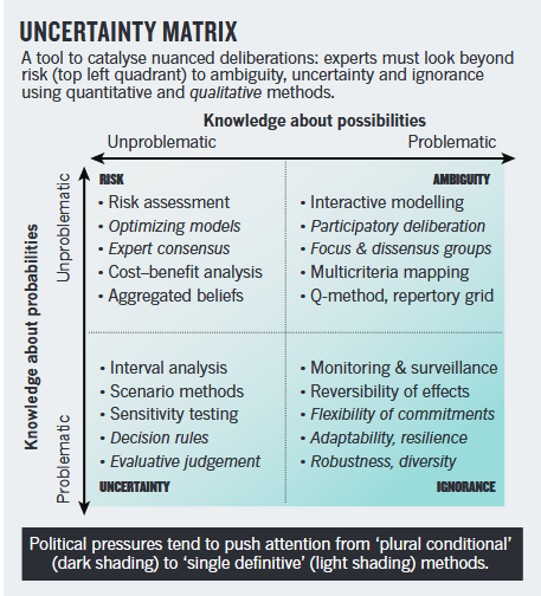
I believe there exists another fundamental axis to this matrix, representing the degree of control held by those conducting the study—and therefore characterizing the uncertainty—over the actors whose future actions will actually bring about the situations that are today uncertain. This means that one must clearly situate the position of those characterizing uncertainty relative to those who have the “power” to make certain variables in the model take particular values. In practice, returning to my earlier example of microalgal molecule production, not knowing where photobioreactors will be deployed in Europe is linked to the fact that I—and we scientists and analysts more broadly—do not control the choice of that location once the molecule is discovered. The associated uncertainty, which we may choose to treat probabilistically or not, arises from the absence of means to constrain the development process, to ensure that development will follow the results of the study itself. Such an axis is essential to complement Stirling’s matrix, but also the more common distinctions between epistemic uncertainty, due to lack of knowledge, and ontological or aleatory uncertainty, due to the modeled process itself and therefore irreducible. These latter distinctions, the most commonly used to qualify uncertainty in modeling, completely fail to notice or indicate the plurality of subjectivities involved: there are phenomena, some uncertain by nature (chaotic), others requiring us to get more knowledge. But who is this “us”? In prospective analysis, the uncertain “phenomena” are largely the decisions of actors. One might call this axis the axis of polycentricity, since it recognizes the multiplicity of actors and interests forming a polycentric system and therefore requires moving beyond a view of uncertainty as a property of phenomena and of knowledge about them, toward an understanding of uncertainty as also emerging from the confrontation between multiple actors. One may observe that characterizing uncertainty as irreducible or aleatory implicitly indicates what would be needed to reduce it: obtain knowledge and you reduce epistemic uncertainty, whereas nothing can be done about irreducible uncertainty. In the same way, uncertainty due to polycentricity disappears when the interests of the actor who brings about the value of a given variable align with those of the analysts assessing that uncertainty. For example, the more the economy tends toward democratic planning, the more interests align, and the more the associated “uncertainty” diminishes. I stop here because something more operational would need to be written in a proper article. By adding this axis, and thus limiting the mystifying potential associated with characterizing uncertainty, we ensure that the future is not closed by presenting purely mathematical objects artificially stripped of their political content.
Beyond treating uncertainty in a way that does not close the future, the distinction between Future and Becoming can be made even clearer by using scenario discovery. I have mobilized this approach in prospective LCA in two scientific papers (Jouannais et al., 2024, 2025), and the general idea is simple. The opposite of scenario discovery is what we usually do in prospective analysis: we try to establish a priori scenarios that are more or less possible, more or less probable, using a range of participatory techniques that are sometimes not far from divination. In practice, this may also consist in defining probability distributions for model parameters and propagating them through Monte Carlo simulations to obtain a cloud of output points that one can interpret as the probability of impacts (for an LCA). Scenario discovery reverses the problem. You define what you would like to obtain—for example, that your system be less impactful than another—and you search for the scenarios (the groups of input parameter values) that allow the objective to be reached. In practice, this means simulating a very large number of cases with minimal prior knowledge beyond minimum and maximum bounds (without any research or expert consultation I can assert that the global atmospheric temperature in 2080 will be between −20 and +50 °C), and then using an algorithm to identify the clusters of cases that satisfy the objective. The oppositional potential of this approach is very large. It avoids forcing the definition of mathematical probabilities as inputs when the situation should not permit it. One can apply probabilities to inputs where Becoming dominates, and apply the algorithm where the Future prevails. The method then identifies futures that satisfy the desired objective, given the probabilistic becoming of certain parameters. These results can then be used in two ways. First, to guide our Future, meaning to work toward bringing about the scenarios that were discovered. Probabilistic uncertainty then remains limited to parameters over which our work has no influence, typically poorly understood natural phenomena or socio-economic processes beyond our control. But there is no “uncertainty” regarding the parameter values defining the Future circumscribed by the algorithm; they are the values toward which we move. One can also proceed without any probabilistic uncertainty at all, treating all parameters identically as variables that can be circumscribed by the algorithm and then reflecting on how to bring those situations into existence. And what if it appears that the discovered scenarios are impossible? Very well—you have determined that the probability of achieving your objective is zero, even though you were unable to define probabilities as inputs. It is much easier to reason about probabilities for a group of specific scenarios than to define probability distributions, often interdependent, for each individual parameter.
Such approaches help demystify uncertainty and prospective analysis because they are easily reinterpret-able and reusable. When a team of experts conducts prospective modeling and eventually publishes a probability derived from a model, even with the greatest transparency and intellectual honesty possible, their assumptions and input probabilities remain hidden in the internal mechanisms of models that are incomprehensible to most people. Even their colleagues rarely have the time to examine everything in detail. The published probability thus appears, by virtue of the division of labor and the conditions of its production, as a fetishized mathematical object, meaning that it takes on a role independent of the assumptions supporting it. It becomes the probability of the event, rather than the result of a specific analytical exercise with a defined question and assumptions. In other words, we forget that it is conditional: P(Event | all our assumptions). It is repeated in one article, then another, and eventually, at the end of the transmission chain, one hears that there is a 5% chance that global warming will remain below 2 °C before 2100 (Raftery et al., 2017). Taken as such, this information is unusable and depoliticizing because the input probabilities of the model concern variables that are demographic and socio-economic—variables we can act upon—as well as natural ones, such as the climate’s response to emissions. Once again, this is explained in the article itself, but once the probability passes through the media sphere it becomes fetishized and reduced to a mathematical object of the same nature as the probability of rolling a six with a fair die (1/6). Continuing with this example, the authors of the study later published another work (Liu & Raftery, 2021) that emphasizes the Future rather than the Becoming by showing that states would need to increase their annual rates of greenhouse gas emission reductions by 80% to have a chance of staying below 2 °C. The probability of remaining below this threshold if emission reductions matched the commitments made in the Paris Agreement (which are themselves mostly not being met) would be 26%. We can already see that this probability and its associated information are less opaque and less fetishized: an input parameter has been extracted from the probabilistic structure of the model in order to determine the value it should take to achieve the objective. One is thus asserting a Future—political and decidable—rather than a naturalized mathematical Becoming. The next step would precisely be scenario discovery, extracting all parameters on which action is possible and presenting the sets of parameter values that allow the objective to be achieved. There is no need to struggle to identify correlations between them; one can treat them all as independent a priori and simply present the sets. There is also no need to make assumptions about economic growth, demography, or the carbon intensity of growth—the algorithm will indicate what these values would have to be to reach the objective. Everyone then gains access to the inner workings of the model by observing these parameter sets and can reflect on whether they are possible and, if so, how. There is no longer a fetishized probability but a set of futures visible to all. At the end of the transmission chain, the media (independent and socialized, of course) would share the characteristics of these scenarios, stimulating discussion rather than apathy and fatalism. And if no solution appears possible within the current economic system, one takes note—and changes the system.
PLUMBER RESIGNATION
LCA has the drawback of having many qualities. In this sense, it benefits from a kind of halo effect, the cognitive bias that leads us to attribute many additional qualities to something that has merely demonstrated a few. Because LCA indeed has the capacity to quantify numerous components of the system at the interface between the anthroposphere (humans) and the ecosphere, we are led to fetishize its results as if they were real attributes of the products and decisions being studied. Numbers hypnotize; they give an impression of truth-telling, and their abundance—together with the breadth of the processes modeled—creates an impression of completeness. LCA thus appears as the systemic analysis par excellence. If it takes “everything” into account, then why do anything else? Moreover, it is relatively simple for an approach that supposedly accounts for everything, and it can now be performed even faster with AI… It can then produce millions of numbers in abundance, for dozens of different specifications and the same number of sectoral regulations, filling the supermarket of regulations of neoliberalism and its governance by numbers. It will construct mathematical abstractions hidden within probability densities, mixing together Future and Becoming, politics and physics, ethics and conflicting interests. It will make it possible to showcase the small steps taken in the right direction, the small percentages of impacts shaved off the production of a useless gadget that will then have earned its green label, allowing ten times more of it to be produced and thereby offsetting a thousand times the initial “environmental gain.” Such uses of LCA must be widely questioned and actively resisted in our practice.
Quantification through LCA becomes oppositional when it is demystified, popularized, and made accessible, and when it contributes to building a new understanding of the world—one that illuminates the mechanisms of death and suffering in society and works to dismantle them. Astronomy and physics led us to abandon geocentrism and the dogmas it sustained; ecology and biology made us aware of our place within the living world; sociology revealed the falsity of simplistic political myths. LCA and the sciences of sustainability modeling must reveal the continuum between society and environment, between production, decisions, and the suffering inflicted. It must also take its place within governance by numbers, but above all enter into the struggle over numbers: a fundamental struggle over which indicators we choose to observe and which we choose to ignore. Political struggle is to a large extent a struggle over the indicators that define the health of the world.
Without this, the very qualities of LCA also make it entirely suitable for supporting a trajectory of technosolutionist and destructive acceleration in the world. Yes, it can limit the damage, in the same way that policies accompanying capitalism temporarily ease social tensions, but it also appears today as a tool for marginally amending a dynamic inherent to capital.
In her address for the prestigious Richard T. Ely Lecture (Duflo, 2017), Esther Duflo, awarded the Sveriges Riksbank Prize in Economic Sciences, suggested that the economist should now think of themselves as a plumber. They should partly set aside theory in order to focus on the practical implementation of effective solutions to localized, concrete problems, such as determining the best way to deliver development aid in a particular locality. This implies a specialized, empirical knowledge used by the economist—now a technician of the world’s flows—mobilized by decision-makers on questions concerning the implementation of specific policies. I have no doubt about Ester Duflo’s sincerity or competence in her commitment to reducing poverty and inequality. But this vision of plumbing depresses me—not out of a snobbish or adolescent rejection of a practice perceived as less legitimate or less grand than “great” theory, but because I believe that the runaway dynamics in social, political, and environmental spheres are such that they render patchwork solutions insignificant. LCA must not become another tool of the plumbing of the End of History. If, as a tenant, you pay rent for an unsanitary, mold-ridden slum that threatens your physical and psychological health every second, and your landlord, magnanimously, sends you a plumber merely to repair the sink, you would be right to think that this plumber is ridiculous, or even that he is a complicit bastard. I have never wanted to be that landlord, but I sometimes fear becoming that plumber.
REFERENCES
Cereseto, S., & Waitzkin, H. (1986). Economic development, political-economic system, and the physical quality of life. American journal of public health, 76(6), 661–666. https://doi.org/10.2105/ajph.76.6.661
De Bortoli, A., Chanel, A., Chabas, C., Greffe, T., & Louineau, E. (2025). More Rationality and Inclusivity are Imperative in Reference Transition Scenarios Based on Iams and Shared Socioeconomic Pathways—Recommendations for Prospective Lca. Elsevier BV. https://doi.org/10.2139/ssrn.5195295
De Lagasnerie, G. (2025). Par-delà le principe de répression : Dix leçons sur l’abolitionnisme pénal. Flammarion.
Duflo, E. (2017). The Economist as Plumber. American Economic Review, 107(5), 1‑26. https://doi.org/10.1257/aer.p20171153
Engels, F. (1878). Anti-Dühring: M. Eugen Dühring bouleverse la science.
Funtowicz, S.O., Ravetz, J.R. (1990). Epilogue. In: Uncertainty and Quality in Science for Policy. Theory and Decision Library, vol 15. Springer, Dordrecht. https://doi.org/10.1007/978-94-009-0621-1_16
Funtowicz, S. O., & Ravetz, J. R. (1993). Science for the post-normal age. Futures, 25(7), 739‑755. https://doi.org/10.1016/0016-3287(93)90022-L
Jouannais, P., Blanco, C. F., & Pizzol, M. (2024). ENvironmental Success under Uncertainty and Risk (ENSURe) : A procedure for probability evaluation in ex-ante LCA. Technological Forecasting and Social Change, 201, 123265. https://doi.org/10.1016/j.techfore.2024.123265
Jouannais, P., Marchand-Lasserre, M., Douziech, M., & Pérez-López, P. (2025). When is Agrivoltaism Environmentally Beneficial? A Consequential LCA and Scenario Discovery Approach. Environmental Science & Technology, acs.est.5c04479. https://doi.org/10.1021/acs.est.5c04479
Knight, F. H. (1921). Risk, Uncertainty, and Profit. Houghton Mifflin. https://doi.org/10.34156/9783791046006-108
Konradsen, F., Hansen, K. S. H., Ghose, A., & Pizzol, M. (2024). Same product, different score : How methodological differences affect EPD results. The International Journal of Life Cycle Assessment, 29(2), 291‑307. https://doi.org/10.1007/s11367-023-02246-x
Lena, H. F., & London, B. (1993). The Political and Economic Determinants of Health Outcomes : A Cross-National Analysis. International Journal of Health Services, 23(3), 585‑602. https://doi.org/10.2190/EQUY-ACG8-X59F-AE99
Lénine, V. I. (1917). L’État et la révolution.
Liu, P. R., & Raftery, A. E. (2021). Country-based rate of emissions reductions should increase by 80% beyond nationally determined contributions to meet the 2 °C target. Communications Earth and Environment, 2(1), 1‑10. https://doi.org/10.1038/s43247-021-00097-8
Marx, K. (1845). Theses on Feuerbach.
Mespoulet, M. (2012). Instrumentation statistique et action de l’État : Le cas soviétique: Éducation et sociétés, n° 30(2), 89‑106. https://doi.org/10.3917/es.030.0089
Navarro, V. (1992). Has Socialism Failed? An Analysis of Health Indicators under Socialism. International Journal of Health Services, 22(4), 583‑601. https://doi.org/10.2190/B2TP-3R5M-Q7UP-DUA2
Priewe, J. (2020). Why 60 and 3 percent ? European debt and deficit rules—Critique and alternatives, IMK. In IMK Study, (Numéro 66). Institut für Makroökonomie und Konjunkturforschung (IMK), Düsseldorf. https://nbn-resolving.de/urn:nbn:de:101:1-2020052612570065992221
Raftery, A. E., Zimmer, A., Frierson, D. M. W., Startz, R., & Liu, P. (2017). Less than 2 °C warming by 2100 unlikely. Nature Climate Change, 7(9), 637‑641. https://doi.org/10.1038/nclimate3352
Sacchi, R., Terlouw, T., Siala, K., Dirnaichner, A., Bauer, C., Cox, B., Mutel, C., Daioglou, V., & Luderer, G. (2022). PRospective EnvironMental Impact asSEment ( premise ) : A streamlined approach to producing databases for prospective life cycle assessment using integrated assessment models IMAGE. Renewable and Sustainable Energy Reviews, 160(April 2021), 112311. https://doi.org/10.1016/j.rser.2022.112311
Saltelli, A., Bammer, G., Bruno, I., Charters, E., Di Fiore, M., Didier, E., Nelson Espeland, W., Kay, J., Lo Piano, S., Mayo, D., Pielke, R., Portaluri, T., Porter, T. M., Puy, A., Rafols, I., Ravetz, J. R., Reinert, E., Sarewitz, D., Stark, P. B., … Vineis, P. (2020). Five ways to ensure that models serve society : A manifesto. Nature, 582(7813), 482‑484. https://doi.org/10.1038/d41586-020-01812-9
Sareen, S., Saltelli, A., & Rommetveit, K. (2020). Ethics of quantification : Illumination, obfuscation and performative legitimation. Palgrave Communications, 6(1), 20. https://doi.org/10.1057/s41599-020-0396-5
Serna, P. (2019). L’extrême centre ou le poison français : 1789–2019. Champ Vallon.
Supiot, A. (2015). La gouvernance par les nombres. Fayard.
Stirling, A. (2010). Keep it Complex—4681029a. Nature, 468(1031).
Thompson, E. L., & Smith, L. A. (2019). Escape from model-land. Economics, 13, 1‑15. https://doi.org/10.5018/economics-ejournal.ja.2019-40
van der Giesen, C., Cucurachi, S., Guinée, J., Kramer, G. J., & Tukker, A. (2020). A critical view on the current application of LCA for new technologies and recommendations for improved practice. Journal of Cleaner Production, 259. https://doi.org/10.1016/j.jclepro.2020.120904
Weidema, B. P., Pizzol, M., Schmidt, J., & Thoma, G. (2018). Attributional or consequential Life Cycle Assessment : A matter of social responsibility. Journal of Cleaner Production, 174, 305‑314. https://doi.org/10.1016/j.jclepro.2017.10.340