
Advertising and any effort aimed at creating desire in order to sell off stocks of commodities are generally recognized as pillars of capitalist society that ought to be abolished. Television commercials showing SUVs conquering pristine roads through wild Far West landscapes help construct the imaginary of freedom associated with them. An imaginary that will push the consumer to take out a loan to put those two tons of metal to work during the fifty minutes spent stuck in traffic on the ring road for their daily commute. Advertising activates all sorts of desires, manipulating powerful imaginaries—sexist, speciesist, racist, etc.—and, more generally, the ideal of individual success according to the criteria of neoliberalism. Advertising obviously plays an essential role in the mechanisms of supply and demand, but I am not aware of analyses examining its effect within the sphere of production. One of the strengths of Marxist analysis is that it focuses attention on production, whereas neoclassical approaches are essentially theories of consumption, supply, and demand. Recently I was thinking that the issue of advertising could also be addressed through the arithmetic lens of the rate of exploitation, a fundamental indicator of capitalism in the Marxist framework. Advertising—and more generally any discourse encouraging the individual to become an “entrepreneur of the self” could be seen as factors that intrinsically increase the rate of exploitation. Let me explain.
A BRIEF REMINDER ABOUT EXPLOITATION
To avoid having to read the rather arduous Capital, I strongly recommend Christophe Darmangeat‘s very pedagogical book The Enigma of Profit (2024) for a clear explanation of theories of value and profit. Here I will simply recall the essentials.
For Marx, exploitation is not morally defined. Whether your boss is nice or not, whether there is a foosball table in the cafeteria or not, you are exploited because of the social relation within which labor is performed. If your boss does not own the company, they are in fact exploited just like you. Exploitation describes the fundamental situation of capitalism in which the worker, who does not own the means of production (the factory, the digital platform, the application that connects customer and worker, etc.), creates through their labor a value greater than their wage, which is then appropriated as profit by the owner. Marx, following Smith and Ricardo, shows that the value of commodities comes from human labor, more precisely from the socially necessary labor time required to produce them. This means that the value of a commodity is not determined by the productivity of the particular worker producing it, but by the average productivity of all firms and workers producing that commodity. If a commodity requires 20 hours of human labor plus 1 hour of machine operation, where the machine itself required 1000 hours of labor to produce and has a lifetime of 2000 hours, the value of the commodity is therefore: 20 + (1/2000 × 1000) = 20.5 hours of labor. Labor power, in the form of working time, is also a commodity under capitalism. Its value is therefore calculated in the same way: how many hours of human labor are required to produce one hour of human labor? This is the value of the reproduction of labor power.
Concretely, for a worker to provide one hour of labor, they must maintain sufficient health to return to work the next day, and they must also reproduce themselves biologically, producing children for future labor hours. They therefore require a minimum basket of consumption goods: housing, a bed, food, leisure, etc. This set of commodities produced within capitalism corresponds to a certain amount of labor time, which in turn determines the value of reproducing labor power. However, if the owner of the means of production pays wages and production tools at their value, and sells commodities at their equivalent labor-time value, nothing remains. Profit is therefore the portion of value created by workers that is not returned to them as wages. The capitalist, by virtue of owning the means of production, forces the worker to labor longer than necessary to reproduce their labor power, appropriating the surplus value produced during the remaining labor time. This is exploitation.
The rate of exploitation is defined as surplus value divided by wages. This rate is a key indicator of capitalism and a central stake in the class struggle.
Capitalists seek to maximize it in three ways. First, through absolute exploitation, by extending working hours so that the worker spends more time producing surplus value beyond what is necessary to reproduce their labor power. Second, by suppressing wages, keeping them as low as possible through mechanisms such as breaking strikes, weakening or destroying unions, and generally limiting workers’ bargaining power. Third, through relative exploitation, by increasing productivity—for example through mechanization—so that the worker can produce the equivalent of the value of their labor power more quickly and therefore spend a greater portion of the working day generating surplus value for the capitalist. This last method is comparatively “softer” and often less visible, unless one carefully observes the relative evolution of productivity and wages.
Today capitalism struggles to increase productivity significantly, so it increasingly relies the first two means: refusing concessions of the « social democracy », attacking unemployment insurance, mobilizing racist divisions and other forms of domination, invoking the specter of war, and stripping workers of collective structures to force them to sell their labor even more cheaply.
THE VALUE OF LABOR POWER DEPENDS ON THE REGIME OF DESIRE
Returning to work the next day—or even simply enduring a day’s work—requires a minimum level of health. This is not merely a matter of avoiding death from cold, hunger, thirst, or disease. The explosion of burnout and workplace suicides reminds us that health is multidimensional, including physical, psychological, and social aspects. A worker who is fed and rested cannot work if they are psychologically destroyed. Mental health depends heavily on social conditions of existence and on the regime of desire to which individuals are exposed. Desire—the movement toward filling a lack—is the motor of human action: the desire not to die, the desire for recognition, for love, for relief from suffering. And along with these comes the intermediate desire to possess certain commodities in order to be recognized and valued.
Schopenhauer, with his characteristic optimism, wrote that “Life swings like a pendulum, backward and forward, between pain and boredom; these are its two elements. A human deprived of desire—for example, because they are deprived of social interaction that would allow comparison, projection, and imitation (desire is highly mimetic)—falls into apathy and boredom. Conversely, desire constantly shifts its object and is associated with lack and suffering. To play with desires, to manufacture desires through advertising, is to change the tempo of Schopenhauer’s pendulum—to make it frantic, but above all to tilt it toward desire and suffering. Exposure to advertising creates perpetual lack, with a new object for each new injunction. It is crucial to highlight that there is no fundamental difference between the desire not to die and the desire to be recognized in a social group. This means there is no fundamental difference between “primary” and “secondary” needs in terms of what generates them and what they generate.
A human being may go on hunger strike if they desire the usefulness of their cause more than satisfying their hunger. A Buddhist monk practicing Sokushinbutsu may literally mummify himself alive if he desires sainthood within his religion. It is true that “secondary” needs cannot be satisfied if one is dead, but an extreme hunger for social recognition can be just as obsessive and motivating as hunger for food.
Adorno among others strongly criticized the categorization of needs:The question of the immediate satisfaction of need should not be posed in terms of social and natural, primary and secondary, true and false; rather it falls with the question concerning the suffering of the vast majority of human beings on Earth.” From this observation, it becomes clear that the needs required to reproduce labor power depend on the regime of desire imposed on the worker. If workers are constantly subjected to advertising-generated needs, maintaining their mental and social health requires ever-increasing consumption, and the value of an hour of labor therefore rises proportionally—much like improved nutrition increased human skeletal growth and thus caloric needs.
How does this affect the rate of exploitation? In practice, if the worker returns the next day, it means their labor power has been renewed physically and psychologically. But it is entirely possible that the manufacturing of desires creates a real reproduction cost higher than what wages cover, leading in the medium or long term to burnout, depression, or worse. In that case, the value of reproducing labor power is not respected, which effectively increases the portion of working time generating profit at the expense of worker health—much like chronic undernutrition eventually exhausts the worker. We therefore have to define a real rate of exploitation that takes into account whether the reproduction value of labor power is actually covered. This latter value then becomes visible, and it is increased by the manufacture of desires. We then see that once the worker’s labor has covered the value of their reproduction, the worker devotes every minute of their time to increasing surplus value and, through the share devoted to advertising, to increasing the value of their own reproduction. The real rate of exploitation is therefore doubly increased by the rise of the two terms in the numerator.
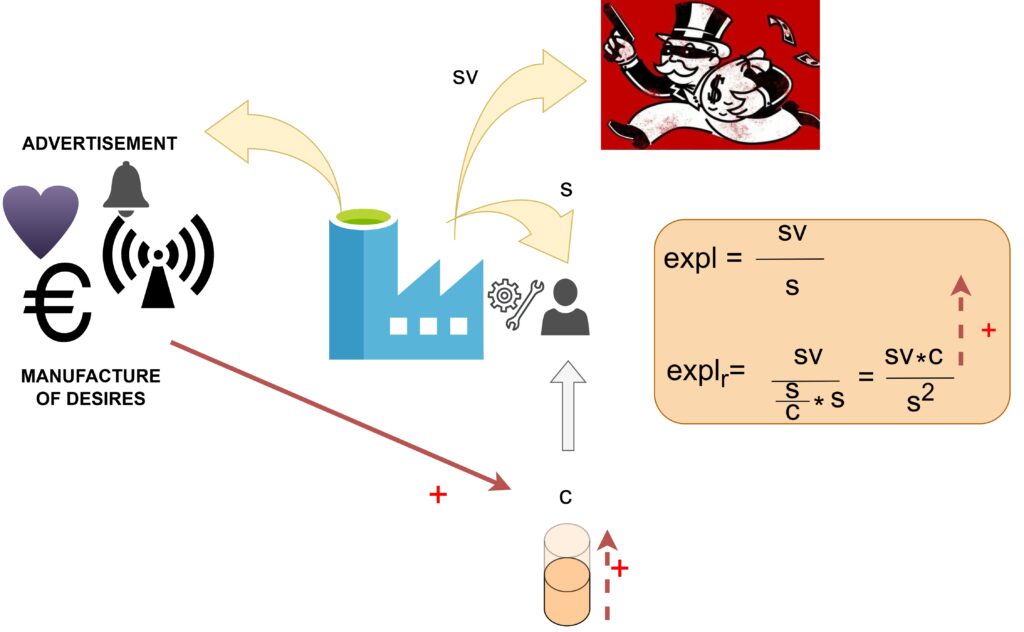
By creating desires and thereby increasing the worker’s needs, capitalism raises the rate of exploitation while wages remain unchanged. In order to sell off its stocks of commodities, capital presents them as symbols of the social success that humans deeply desire. By compressing wages while simultaneously encouraging the desire for an unattainable level of consumption, it squeezes the human being from both sides and places them under heightened tension, thereby increasing the real rate of exploitation
EVERYTHING IS PERMITTED, NOTHING IS POSSIBLE
This observation extends beyond advertising. Under neoliberalism, individuals are placed in competition with one another and markets extend into increasingly intimate spheres, often with the support of the state. The dominant discourse urges individuals to view themselves as enterprises competing with other enterprises, measuring their human worth according to the value the market assigns to them. The neoliberal “new man” runs endlessly on a treadmill where any weakness threatens economic, social, or symbolic survival. Any deviation from the quest for self-improvement increases the risk of personal bankruptcy. One must invest constantly in oneself and one’s descendants: private tutoring, life coaches, fitness coaches, nutritional supplements, cosmetic supplements, bigger cars, new phones, new wardrobes, endless upgrades of everything. Gradually the cost of individual R&D explodes—or at least the desire for it does—leaving those who cannot keep up feeling defeated. Neoliberalism transforms the psychological suffering of unsatisfied desire, exacerbated by capitalist advertising, into social downgrading for anyone who fails to comply. Capitalism and neoliberalism imply that“Everything is permitted, nothing is possible.”But the neoliberal injunction intensifies this tension, increasing the cost of reproducing labor power and thus the rate of exploitation.
Ultimately, every attack on the human psyche—through the manipulation of desires, through the stultification by work, through the humiliation of defining human value solely through the market—increases the cost of maintaining psychological and social health. And thus it increases the rate of exploitation, as long as wages do not rise accordingly. But can they ever truly rise enough? What is the true value of psychological and social reproduction of labor power within a system so harmful to the individual? Just as insufficient wages lead to physical undernourishment, forcing the body to consume its own reserves until exhaustion, so too the failure to meet the psychological reproduction costs of labor power means that workers may return to work for a time while actually depleting their very human capital. If neoliberal injunctions and advertising propaganda continue to increase the difficulty of maintaining mental and social health, it is entirely possible that the working class is living in a chronic state of psychological undernourishment, massively exploited, with general exhaustion looming.
References
Darmangeat C., (2024), L’énigme du profit, Paris, La ville brûle
Schopenhauer A. Le monde comme volonté et représentation, I. IV, 57,
Traduction A. Burdeau, PUF (1966.2008) p. 394