
This is an english translation of the article published in Contretemps.
On November 10, 2025, on France 5, the environmental activist Cyril Dion dared to compare the number of deaths caused by Islamist terrorism with those caused by air pollution in France, which is far higher (France 5, 2025). Cries of outrage erupted throughout the political right and even beyond it. It is disgusting. It cannot be compared. It minimizes the November 13 attacks, etc.
These reactions are obviously predictable, given the grip that the far right holds over part of the media world, which manipulates moral panic at the expense of reflection. But for the sake of the argument, let us assume that this indignation is sincere, that it spans a broad political spectrum, and that it reflects an inability—partly cultivated—to think about the mechanisms through which killing occurs in our societies. Because yes, this comparison is entirely valid and illuminating, but unfortunately partly untenable because of the particular place that “ecology” has come to occupy in the political and media spheres, and more generally in the discourse that permeates society as a whole. It is precisely because ecology, pollution, and environmental impacts appear to belong to a distinct, nebulous category, outside the rest of society, that the comparison is shocking. So in what way is the comparison legitimate and generalizable, and how does the current categorization of ecology prevent it and hinder the movement toward a society with less pollution and less terrorism?
To calm the discussion that follows, we must recall that a comparison does not mean treating two terms as perfectly equivalent in all their qualities. Here we are comparing one aspect of the two phenomena: the number of deaths caused. Moreover, saying that A causes more deaths than B does not mean that B is desirable, nor does it minimize the seriousness of B. Once again, reflection should be preferred to moralizing.
Paradoxically, if the comparison is shocking, it is precisely because “terrorism” and “ecology” share the fact that both have been elevated to the status of sacred categories, in the sense that they are treated as completely separate from the rest of human activities. Terrorism is considered inexplicable and must remain so (“to explain is to excuse,” according to Manuel Valls), while ecology is thought to stand above political divisions and must remain so (Marine Tondelier’s idea of “ecology without adjectives”). Any comparison between these objects is therefore doubly intolerable.
NATURAL CATASTROPHE AND SOCIAL CATASTROPHE
In Beyond the Principle of Repression (Lagasnerie, 2025), Geoffroy de Lagasnerie draws on Louk Hulsman, a thinker of penal abolitionism, to suggest thinking in terms of social catastrophes rather than crimes, in the same way that a hurricane is a natural catastrophe. This is a very useful starting point. Terrorism is a social catastrophe whose probability of occurrence is shaped by the structure of society and geopolitics, just as an extreme hurricane becomes more likely as the oceans and the atmosphere warm.
Attribution science applied to climate focuses precisely on determining to what extent anthropogenic climate change is responsible for an extreme weather event. The latest report from the Lancet Global Countdown on Health and Climate Change (Romanello et al., 2025) shows that the number of deaths and social damages associated with climate change has never been higher, with an average of 546,000 deaths per year between 2012 and 2021 linked to heat waves alone—60% more than between 1990 and 2000. Eighty-four percent of lethal heatwave days between 2020 and 2024 would not have occurred without climate change. The number of deaths caused by climate change during the 21st century will reach hundreds of millions or even billions, depending on political choices.
Similarly, an entire branch of research studies the causes of terrorism—a term that itself lies at the center of scientific debate (Bigo, 2005). There is strong consensus about the relationship between the probability of terrorist attacks and military interventionism: whereas the role played by the complex interaction of factors such as education, poverty, and the importance of religion remains difficult to quantify, military interventionism remains the only clearly explanatory variable.
It has thus been shown, on the basis of more than 12,000 attacks, that a country that militarily intervenes in another country is 55 times more likely to be struck in the following year by an attack carried out by a citizen of the targeted country, compared with a country that does not intervene. Each additional thousand soldiers increases the probability of suffering an attack by 19% (Delori et al, 2021). Complementary observations reinforce the conclusion that this is a causal relationship rather than a mere correlation.
A stroke, a respiratory disease, or a heart disease are catastrophes at the individual scale. They are also natural and social catastrophes whose probability is strongly affected by exposure to air pollution. There is likewise a well-established scientific field seeking to trace causal links between pollution and human health (generally referred to as environmental health).
For example, it is possible to determine that one ton of fine particulate matter smaller than 2.5 microns (PM2.5) emitted into the atmosphere leads to a global average of 0.63 years of life lost distributed across the population—up to 4 years when the particle is emitted in dense urban areas (Van Zelm et al., 2016).
The methodology is complex and mobilizes several disciplines, but it can be explained fairly simply. Roughly speaking: we know how to model the trajectory of a fine particle from its emission. Once we know where it travels, we can determine how it changes the initial concentration in the air (atmospheric sciences). We then know the total volume of air inhaled by a human being (physiology—about 4,745 m³ per year, if needed), and therefore the quantity of fine particles inhaled by a person in the arrival zone.
We also know how the probability of developing a given disease increases as the quantity of particles ingested increases, and we know the mortality associated with that disease (statistical epidemiology). We can therefore reconstruct the causal chain.
Knowing that the direct PM2.5 emissions from a 1 km trip in a diesel car for one person are 12.3 mg (Ecoinvent 3.11), and that the average French person drives 35 km per day, we can estimate very roughly that any policy leading to one additional French person becoming dependent on their diesel car for one year will cause 5.5 hours of life to be lost across the population (considering only direct PM2.5 emissions in dense areas).
This small, very simplified calculation is illustrative. In reality it is carried out much more thoroughly and systematically by a large scientific community modeling the causal chains linking production, consumption, emissions, their environmental effects, and human life. Conducting a full Life Cycle Assessment (LCA)—accounting for all stages required for one kilometer driven in a diesel car, from mineral extraction to vehicle recycling, including direct emissions—shows that each time a French person becomes dependent on their diesel car for one year, the total environmental impacts (not only air pollution but also climate change, water consumption, etc.) cause 15 hours of human life to be lost across the population. In the same way that raising the retirement age mechanically increases the number of workers who die before being freed from the necessity of selling their labor and time to an employer.
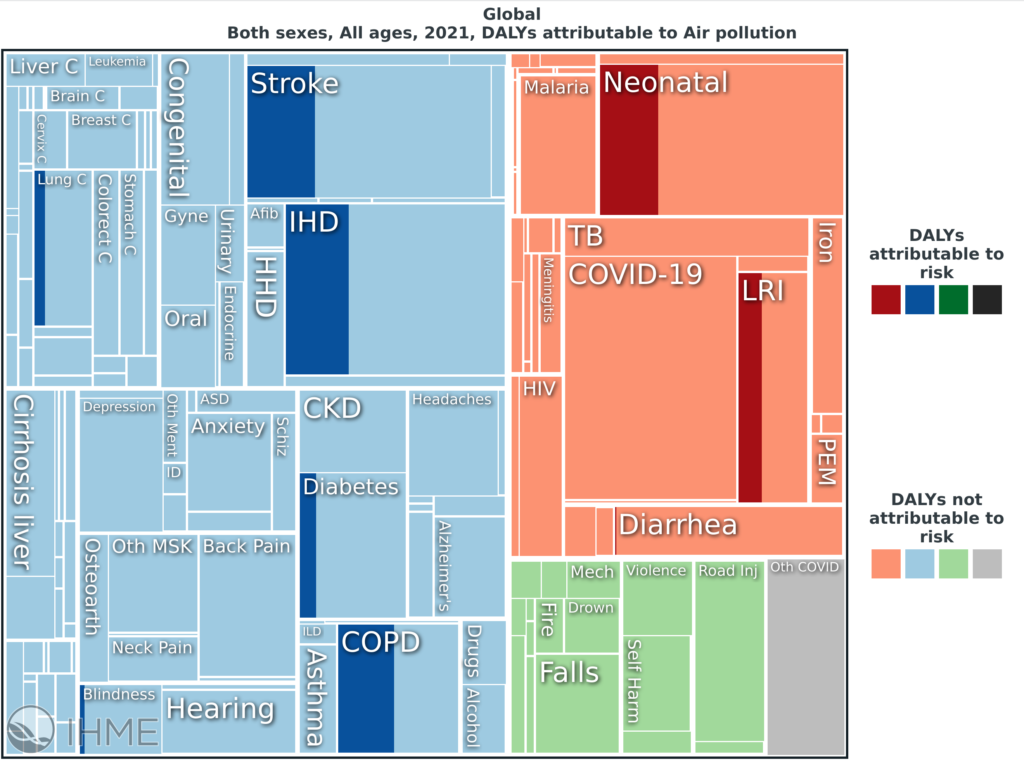
More precisely, within the scientific community working on these questions, lost healthy life years are typically measured in DALYs (Disability-Adjusted Life Years). A person dying one year before their statistical life expectancy corresponds to one DALY, but a person living a year in poor health corresponds to a fraction of a DALY depending on the severity of the condition: 1 for death, 0.54 for the terminal phase of brain cancer, and 0.006 for chlamydia (GBD, 2024).
In other words, 166 years with chlamydia equals dying one year earlier than expected. Think about that.
DALY is notably the unit used in the Global Burden of Diseases, Injuries, and Risk Factors Study, a large interdisciplinary scientific initiative that for thirty years has quantified the population-level impact of diseases and risks—essentially everything that reduces humanity’s health relative to an optimal state without these conditions.
In the latest 2023 report (Hay et al., 2023), we learn that air pollution is the second most impactful risk factor in the world, responsible for 8.4% of the 2.80 billion DALYs worldwide in 2023. Well ahead of harassment (0.19%), or sexual violence against children (1.1%), to remain within these unbearable comparisons. But that is precisely the strength of the approach. “Ecology” does not exist as such here; causes and risks are treated in the same way. They can simply be ordered by category for visualization purposes, but fundamentally the statistical and modeling work is the same.
Beyond discussions about the complexity of the methodology and the associated uncertainty—which occupy the scientific community—we must note the political power of a unit such as the DALY. Society is crossed by causal mechanisms that produce suffering and death. Health is damaged and lives are taken through terrorism, sexual violence, and pollution. These are simply different causal chains.
BLOWING UP THE CATEGORIES
In fact, there is an important difference between the two causes of mortality. Pollution, unlike terrorism, is generated by the production of goods and services that provide utility to the population. Humanity affects its environment as it develops. Development provides goods and utility; pollution works against it, and the exercise appears to be one of optimization. Except that society does not really function as the result of a model that has been optimized: it is structured by relations of class and power, of which the environment is one modality of struggle. The DALYs associated with environmental causality are obviously not distributed uniformly across the population or across the planet, and the enjoyment generated by the associated consumption is not distributed uniformly either. This is an obvious point worth recalling.
Nevertheless, it is precisely this optimization logic that motivates the notorious model of William Nordhaus, recipient of the Bank of Sweden Prize (abusively called the “Nobel Prize in Economics”) for showing that the optimal level of global warming that would maximize economic growth (considered desirable in itself) would be +3°C by 2100 relative to the preindustrial era. Such a catastrophic conclusion was to be expected given the model itself, which is catastrophic and today widely criticized by many economists and climatologists.
But let us set aside the model’s dubious assumptions, its fanciful neoclassical economics, and its shaky mathematical representation of the economic damages of climate change. The general idea is interesting: “ecology,” reduced here to the climate variable, is simply one variable among others. An essential variable, of course, given the suffering it causes and will cause. Again, there is no minimization here.
Economic and scientific models are often criticized for their simplifying assumptions and for omitting “real” complexity. But it is precisely this exercise in cold reductionism that makes thinking possible and, incidentally, desacralizes categories that are created in discourse and eventually become empty signifiers—that is, words that are used but refer to nothing concrete, or else refer to too many different things.
Ecology, the environment, the climate (etc.) have become empty signifiers. Each time “ecology” is put forward as the main cause—rather than killing through environmental causalities—we mobilize a category that has become incomprehensible and detestable to part of public opinion.
The fact that this category has been emptied of meaning is demonstrated every day. In response to Cyril Dion, the Union of Senior Officers of Internal Security Police (SCSI) declared on X that “Cyril Dion minimizes Islamist terrorism compared with global warming,” while sharing the excerpt in which Dion was speaking about air pollution. Without wanting to nitpick, air pollution is not the same thing as global warming. Of course, one does not expect a police union to be specialists in environmental sciences, but this example is symptomatic of the use of the term “global warming” to designate essentially everything that falls under the category of “environment.”
In a similar vein, in a delirious climate-astrophysics denialist rant that is worth seeing, Michel Onfray mocked the argument that toilet flushing would be responsible for global warming. But nobody says that—ever. At most it might affect water consumption, but not global warming, or only in an entirely anecdotal way.
This is also illustrated by the surprise—again, which we will charitably assume to be in good faith for the sake of the argument—of part of public opinion that sees major climate activists like Greta Thunberg mobilizing against colonization and genocide in Palestine. Why would she be interested in that now? This simple astonishment is extremely serious and testifies to the separate positioning of the category “ecology” in public discourse.
It is partly due to the positioning of “ecologists” themselves, who have defined themselves simply as such. This public engagement has, moreover, made Thunberg far less acceptable to authorities, who can easily deploy discourse “for the planet,” whereas a firm denunciation of genocide is far less easily appropriated by the leaders of states supporting Israel in its actions.
In a less charitable interpretation, one might say that Thunberg’s original opponents feign surprise and oppose her activism for Palestine in the same way they opposed her activism for the climate: they continue their commitment to the death and suffering of certain populations first and foremost. Thunberg is consistent in her commitments here, and she breaks out of the category of environmental activist for the better.
THE DANGER OF EMPTY CATEGORIES
One must not confuse an empty signifier or category with a category without effects. An empty category can become a signifier with immense mobilizing power. Indeed, one could argue that the same mechanisms of fetishization and sacralization of a word or concept both empty it of meaning and give it the power to move public opinion.
This is why eco-fascism can mobilize the concepts of “environment” and “ecology” in a version completely opposed to the DALY approach. When Dave Foreman, an American “environmentalist” activist, said on the BBC in 1986 that one should let Nature restore its balance when asked about aid to respond to the Ethiopian famine—that is, let people die—he was defending a mystical ecology, sacralizing a divine Mother Nature at the expense of Humanity.
Sacralizing a category also allows an entire social group to construct itself in opposition to it. Here again the parallel with the work of Lagasnerie (and an entire intellectual current (Ricordeau, 2021)) on the category of “crime” is illuminating. Criminalizing—that is, describing social catastrophes through the sacred category of crime and structuring discourse and politics around it—allows social groups against whom society wages war to construct themselves in relation to it. The category of crime becomes attractive, whereas the notion of social catastrophe would be far less so. Here it is the reverse: defending a category called “ecology” allows a social group to hate it as such, especially if it is presented as a moral injunction coming from dominant classes (Comby and Malier, 2022). At 7:30 p.m. in the frozen food aisle, after yet another miserable day in a mind-numbing job producing useless things for capital, being confronted with infantilizing stickers telling us to consume ethically can simply create hatred toward anything “eco-friendly.” If we really insist on liberal consumer-incentive measures, let us replace the “eco-score” with a number of DALYs, or an evocative equivalent. One might then redirect that hatred against the economic system and the miserable salary that forces us to buy a product labeled “equivalent to two years of chlamydia.”
The empty category of the environment nevertheless has a useful strength. One can observe that part of public opinion has come to question the foundations of capitalism, and more generally has become politicized, through the entry point of “ecology.” This is what the economist and Spinozist philosopher Frédéric Lordon notes when he speaks of “climate affect” in Vivre Sans (Lordon, 2019). Climate affect is an idea, a passion that, by itself and without further intellectualization, sets people in motion against the capitalist order. He even regrets this: “What the massacre of human beings did not achieve in public opinion, the massacre ‘of-the-planet’ might make possible. It’s disgusting, but that’s how it is—so let’s deal with it.”(p 255)
One could therefore follow the wind of climate affect—which once again represents more or less the whole of “the environment”—to free the population from other major
sources of DALYs such as back pain (9th cause), depression (11th cause), anxiety disorders (12th cause), etc., for which the political and economic system is largely responsible but which do not benefit from such strong mobilizing power.
This potential is real, but the risk is that an affect based on an empty category is blinding. If the emotional mechanism that makes us react to the word “climate” but not to the word “suffering” is indeed at work, what assurance do we have that when climate consequences cause suffering to all living beings on an unprecedented scale, we will actually respond to it? If we decide that animal suffering deserves moral consideration, what should we do once we know that one kilogram of protein from industrial pork emits about six times less CO₂-equivalent than one kilogram of protein from extensively raised beef (Poor and Nemececk, 2013)? What should we do if it is shown that intensive cattle farming emits less CO₂ than extensive cattle farming (Nijdam et al., 2012)? Should animals be packed together indefinitely? The problem goes beyond the simple “carbon tunnel” that focuses attention on climate change rather than other environmental impacts. It is inherent in thinking in “ecological” terms rather than in terms of suffering and death.
The ethical philosophy mobilized in this article is fundamentally sentientist: it attributes moral value to any being capable of suffering—that is, any sentient being—and places suffering at the center of moral consideration. This perspective obviously includes human beings and constitutes an extension of anthropocentrism, but it is neither biocentric nor ecocentric: “living things” and ecosystems do not possess intrinsic moral value. They derive value from the role they play for sentient beings. This is a philosophical stance that cannot truly be debated, in the sense that one cannot rationally justify the decision to attribute value to suffering beings rather than to “the planet.” One could decide that the planet itself has value, but it is difficult not to drift toward Foreman-style positions and magical appeals to Nature when trade-offs arise involving Humanity and “Mother Nature.”
AGAINST ECOCIDE, « ECOLOGICIDE » ?
In short, the comparison is salutary—and it is not new. By studying the number of Americans exposed to air pollution exceeding legal thresholds, Lynch and Stretesky (2012) already concluded that Americans were 3.6 times more likely to suffer an “environmental crime” of a single category than to suffer street crime. The comparison considers terrorism and pollution by desacralizing them and reducing them to their common nature: different causal chains leading to death and suffering, whose probabilities are shaped by political choices structuring society. By focusing on causal chains, the categories structuring public discourse are blown apart, and ecology disappears for its own sake. Understanding the mechanisms of suffering and killing then makes it possible to identify common factors between terrorism and deaths caused by air pollution, such as the geopolitical destabilization of oil-producing countries in order to secure supply. More generally, the same structural political changes that reduce logics of domination and exploitation also reduce the probability of death from both terrorism and pollution. During a lecture at the University of Lausanne, Frédéric Lordon jokingly referred to a deliberately provocative article title he ultimately decided not to write: “Against ecocide, ecologicide.” His point mainly concerns a part of the political class that proclaims itself ecological but rarely proposes a critique of capitalism and instead promotes the illusion of compromise with it (for example, “ecology without adjectives”). One could perhaps reclaim the slogan in another sense: ecologicide as the destruction of the category of ecological discourse itself. With it, the political camp bearing that name would have to re-categorize itself—on the left, if all goes well. It would leave the sacred dimension to essentialists incapable of thinking about the causality of complex phenomena, and to a right that prefers “thoughts and prayers” after tragedies, thereby ensuring the repetition of attacks and hurricanes within their neatly defined categories.
The comparison proposed by Cyril Dion fully situates ecology within science and within the left, destroying it as a category in order to treat it as an extension of the logics of domination and killing, in continuity with—and intensification of—the difference between those who enjoy and those who suffer.
References
Bigo, D. (2005). L’impossible cartographie du terrorisme. Cultures & Conflits. https://doi.org/10.4000/conflits.1149
Comby, J.-B., & Malier, H. (2022). Les classes populaires et l’enjeu écologique: Un rapport réaliste travaillé par des dynamiques statutaires diverses. Sociétés contemporaines, 124, 37–66. https://doi.org/10.3917/soco.124.0037
Delori, M., Egger, C., Magni-Berton, R., & Varaine, S. (2021). Les interventions militaires sont-elles une cause du « terrorisme » ? De l’utilité des analyses quantitatives pour les études critiques de la sécurité. Cultures & Conflits, 123–124, 37–65. https://doi.org/10.4000/conflits.23183
Global Burden of Disease Collaborative Network. (2024). Global Burden of Disease Study 2021 (GBD 2021) disability weights. Institute for Health Metrics and Evaluation (IHME). https://ghdx.healthdata.org/record/ihme-data/gbd-2021-disability-weights
Hay, S. I., Ong, K. L., Santomauro, D. F., et al. (2025). Burden of 375 diseases and injuries, risk-attributable burden of 88 risk factors, and healthy life expectancy in 204 countries and territories, including 660 subnational locations, 1990–2023: A systematic analysis for the Global Burden of Disease Study 2023. The Lancet, 406, 1873–1922. https://doi.org/10.1016/S0140-6736(25)01637-X
Lordon, F. (2019). Vivre sans. La Fabrique.
Lynch, M. J., & Stretesky, P. B. (2012). Green criminology. In F. T. Cullen & P. Wilcox (Eds.), The Oxford handbook of criminological theory. Oxford University Press. https://doi.org/10.1093/oxfordhb/9780199747238.013.0032
Nijdam, D., Rood, T., & Westhoek, H. (2012). The price of protein: Review of land use and carbon footprints from life cycle assessments of animal food products and their substitutes. Food Policy, 37, 760–770. https://doi.org/10.1016/j.foodpol.2012.08.002
Poore, J., & Nemecek, T. (2018). Reducing food’s environmental impacts through producers and consumers. Science, 360, 987–992. https://doi.org/10.1126/science.aaq0216
Ricordeau, G. (2021). Crimes et peines: Penser l’abolitionnisme pénal avec Nils Christie, Louk Hulsman et Ruth Morris. Grevis.
Romanello, M., Walawender, M., Hsu, S.-C., et al. (2025). The 2025 report of the Lancet Countdown on health and climate change. The Lancet. https://doi.org/10.1016/S0140-6736(25)01919-1
Salle, G. (2019). De la green criminology à l’analyse de la gestion différentielle des illégalismes. Déviance et Société, 43, 593–620. https://doi.org/10.3917/ds.434.0593
Van Zelm, R., Preiss, P., Van Goethem, T., et al. (2016). Regionalized life cycle impact assessment of air pollution on the global scale: Damage to human health and vegetation. Atmospheric Environment, 134, 129–137. https://doi.org/10.1016/j.atmosenv.2016.03.044
France 5. (2025). C dans l’air l’invité – Cyril Dion: Climat: À quoi sert la COP30? https://www.france.tv/france-5/l-invite-de-c-dans-l-air/7665957-c-dans-l-air-l-invite.html